



Article
Shortcuts to article's themes:
> Basics
> Physics
> Aesthetics
> Next-generation Fresnel
> Conclusions

Finding the perfect spot – The art and science of narrowing beam angles
Exploring the role of optics, physics, and aesthetics in achieving tighter spot beams for retail and architectural applications
Achieving increasingly narrow spot beams is a common request in retail and architectural lighting. While the challenge may appear straightforward, beam angles become harder to reduce as the light source grows in size, creating fundamental optical limitations.
At LEDiL, we continuously explore these limits. Finding the optimal solution requires balancing beam angle, efficiency, beam quality, and system size while working within real-world product constraints.
Basics
When evaluating optical performance, FWHM (Full Width Half Maximum) and FWTM (Full Width Tenth Maximum) are two important beam angle metrics.
FWHM describes the width of the light distribution at 50 % of the peak intensity.
FWTM describes the width of the light distribution at 10 % of the peak intensity.
While FWHM indicates the width of the main beam, it does not reveal how much light spreads outside the central area. FWTM provides this additional information, helping to evaluate the overall beam shape and light distribution.
FWHM alone is not sufficient to evaluate the performance of an optical component.
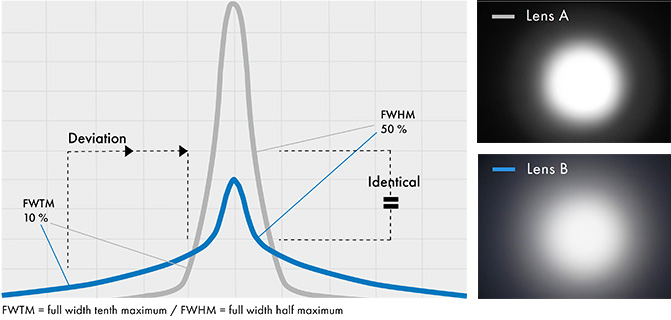
For example, the two lenses shown above have the same FWHM angle, meaning they appear equally narrow when measured at 50 % intensity. However, their overall light distributions are different:
Lens A (grey line) concentrates more light within the central beam, resulting in higher optical intensity (cd/lm) and a narrower FWTM value.
Lens B (blue line) spreads more light outside the central beam area, producing lower intensity and a wider FWTM value.
As a result, two optics can have the same FWHM but deliver noticeably different beam performance. Therefore, both FWHM and FWTM should be considered when comparing optical components.
Physics
Most lighting applications can be accomplished with narrow beams ranging between 15° and 24°, for which typical lighting fixtures and LED sizes are optimised. However, for more specialised tasks, a narrower beam in the 6°–10° range may be necessary. For example, in a museum with a high ceiling, a 15° beam may illuminate a larger area than intended. An 8° beam can provide more precise illumination, although usually with some loss of efficiency. While narrow beams were traditionally achieved with halogen lighting, modern optical solutions offer more effective alternatives.
Optical components such as lenses, and reflectors, control light through reflection or refraction. Although collimators perform best with a theoretical point source, LEDs emit light from a finite surface rather than a single point. As a result, some light deviates from the intended direction. The magnitude of this deviation depends on both the optical design and the size of the LED’s light-emitting surface (LES). A larger LES generally makes it more difficult to achieve ultra-narrow beams.
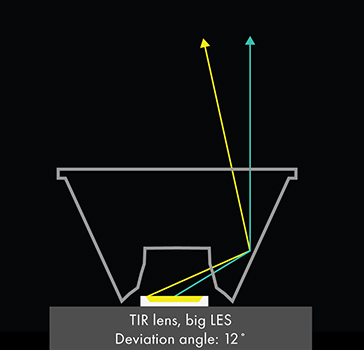
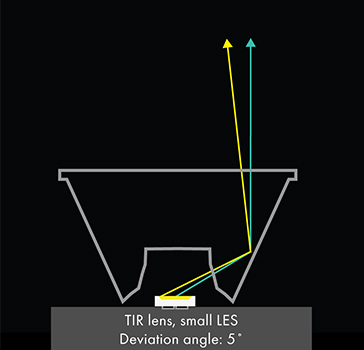
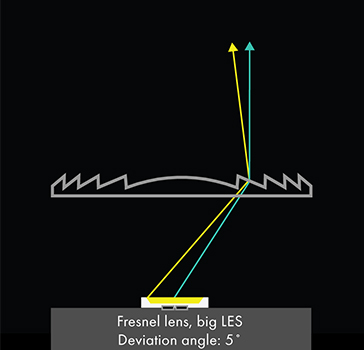
Deviation angles of TIR and Fresnel optics with small and large LES sizes.
For applications that require extremely narrow beam angles, Fresnel lenses can offer an alternative to traditional TIR optics. Positioned farther from the light source, Fresnel lenses can improve collimation and reduce light spill. As shown below, a Fresnel lens used with a large LES can achieve a deviation angle similar to that of a TIR lens paired with a smaller LES.
If further reduction of the deviation angle is needed, either the optic must be enlarged or the LED’s LES reduced. Because narrow beams concentrate light into a smaller area, they produce a higher candela peak and can achieve high intensity with fewer lumens than wider beams. In some cases, multiple small LEDs combined with an array of optics can provide even greater beam control, although this approach often involves design trade-offs.
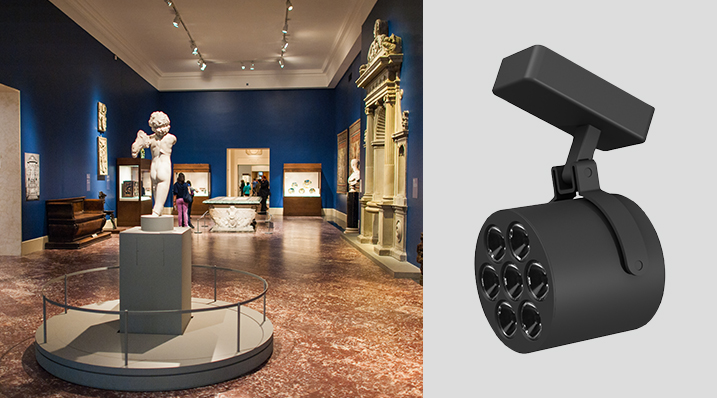
Track light example with multiple LEILA-Y optics for museum lighting.
Aesthetics
The spots are not all the same. A theoretical collimator produces an image of the LED with colour uniformity issues, which the lens needs to compensate for. The beam angle also plays a significant role, as the beam needs a sharp cutoff without much stray light after the main beam.
Achieving a tight beam alone is not enough in many applications. In retail and architectural lighting, the beam must also be aesthetically pleasing. Colour-mixing features within the lens are crucial for high-quality lighting. A lens with effective colour mixing produces beautiful, uniform, state-of-the-art illumination, while a lens without these features can be unsuitable for high-quality spot lighting, despite delivering the narrowest and most intense beam.
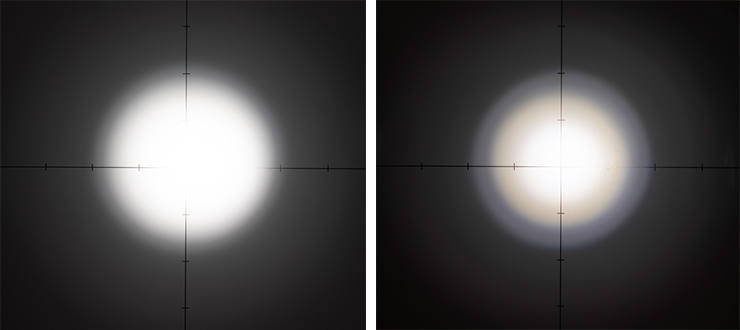
Example of a spot lens with and without colour mixing features.
Next-generation Fresnel
Fresnel lenses have long been valued for their precise collimation, but achieving both high optical performance and aesthetics has remained a challenge. Traditional designs often suffer from colour aberrations and visual inconsistencies, limiting their suitability for applications where both precision and appearance matter.
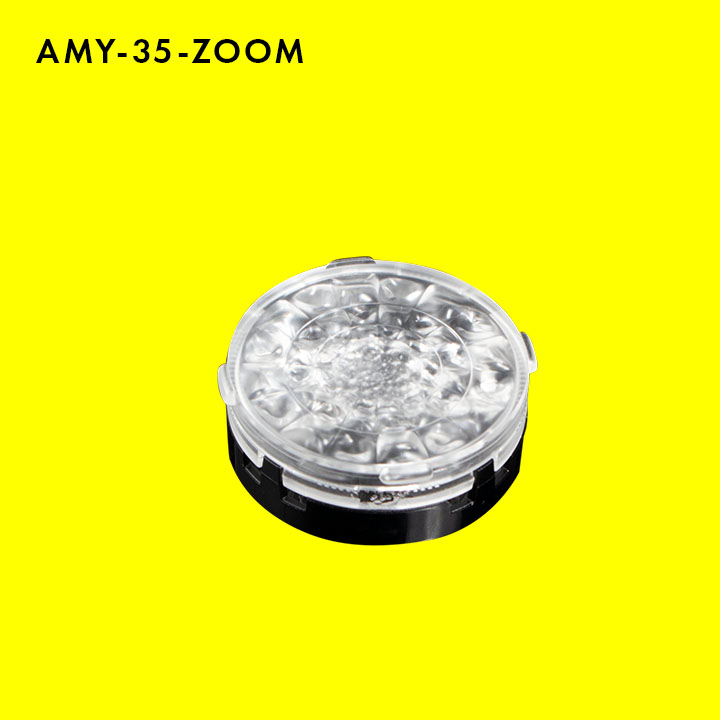
LEDiL’s patent-pending Fresnel solution overcomes these limitations, delivering a narrow beam while significantly enhancing aesthetics. Unlike TIR optics, Fresnel lenses are positioned farther from the light source, allowing for superior collimation and reduced light spill. Although this design may introduce minor optical losses, it ensures that as much light reaches the target as with conventional TIR optics, while providing greater beam precision and improved visual appearance.
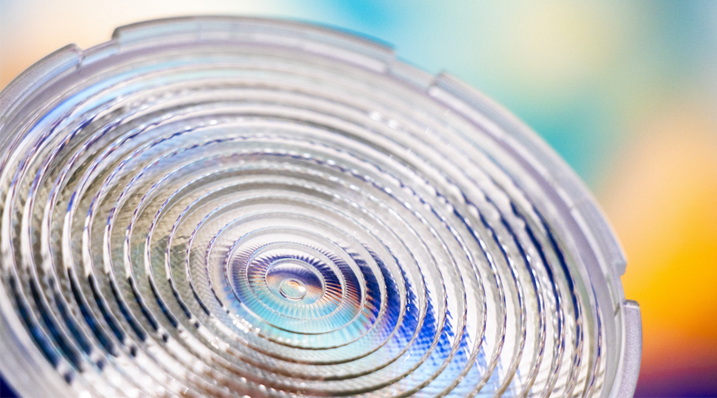
LEDiL’s patent-pending Fresnel solution enables an ultra-narrow beam with exceptional uniformity.
Designed for ultra-narrow (<5°) beam applications, this solution prioritises peak candela (intensity) over total lumens, delivering sharp, high-intensity beams suited for demanding applications.
Key benefits include:
Long-range illumination through highly focused beams.
Dramatic lighting effects with strong contrast and well-defined edges.
Precision lighting for small targets, enabled by minimal stray light.
With these advancements, Fresnel optics have become a powerful solution for applications requiring both precise beam control and high-quality beam aesthetics.
Conclusions
The comparison below summarises the performance of the different optical approaches discussed in this article, including conventional spot optics, Fresnel optics, and multi-optic configurations. It highlights the impact of optic size, LES size, and optical design on beam angle, intensity, and efficiency.
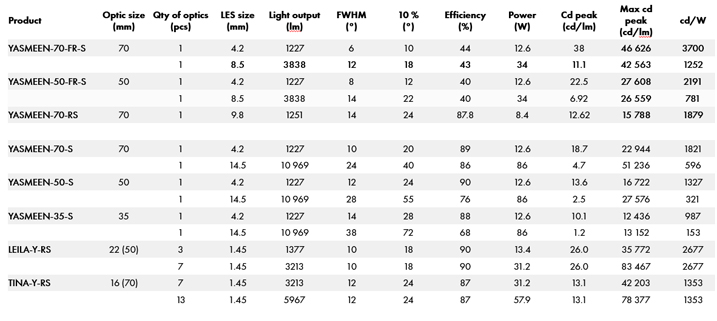
Performance comparison of LEDiL narrow-beam optical solutions.
There is no single optimum solution for achieving narrow beam angles. The best result depends on balancing LES size, optic dimensions, optical design, efficiency, and application requirements. The comparison above demonstrates how different optical approaches can be used to achieve highly targeted illumination.
At LEDiL, we continuously push the boundaries of spot-lighting performance. While some customer requirements may be limited by the laws of physics, we are always eager to explore alternative concepts and collaborate on solutions that best meet application needs.
Contact us today







Shortcuts to article's themes:
> Basics
> Physics
> Aesthetics
> Next-generation Fresnel
> Conclusions